


Running a small business often means doing everything at once—finding new customers, replying to emails, following up with leads, managing sales, and keeping existing customers happy.
The problem is that customer information can quickly become scattered across spreadsheets, email inboxes, WhatsApp conversations, notebooks, and different apps.
That is where a Customer Relationship Management (CRM) system can make a big difference.
The best CRM software for small business can bring your contacts, leads, sales pipeline, follow-ups, communication, and customer information into one organized place.
But with so many CRM platforms available today, choosing the right one can be confusing.
In this guide, we’ll explain what a CRM does, what small businesses should look for, and compare some of the most popular CRM software options so you can choose a platform that fits your business.
What Is CRM Software?
CRM stands for Customer Relationship Management.
CRM software is a tool that helps businesses manage their interactions with current and potential customers.
Instead of keeping customer details in different spreadsheets or applications, a CRM allows you to store important information in one central system.
For example, a CRM can help you track:
- Customer names and contact details
- Leads and prospects
- Sales opportunities
- Follow-up activities
- Emails and conversations
- Sales pipeline stages
- Tasks and reminders
- Customer support information
- Marketing activities
- Sales reports
For a small business, this can mean less manual work and better visibility into what is happening with every customer.
Why Do Small Businesses Need a CRM?
You might think CRM software is only useful for large companies with hundreds of employees.
That’s no longer the case.
Even a small team can benefit from having a centralized system for managing customers and sales.
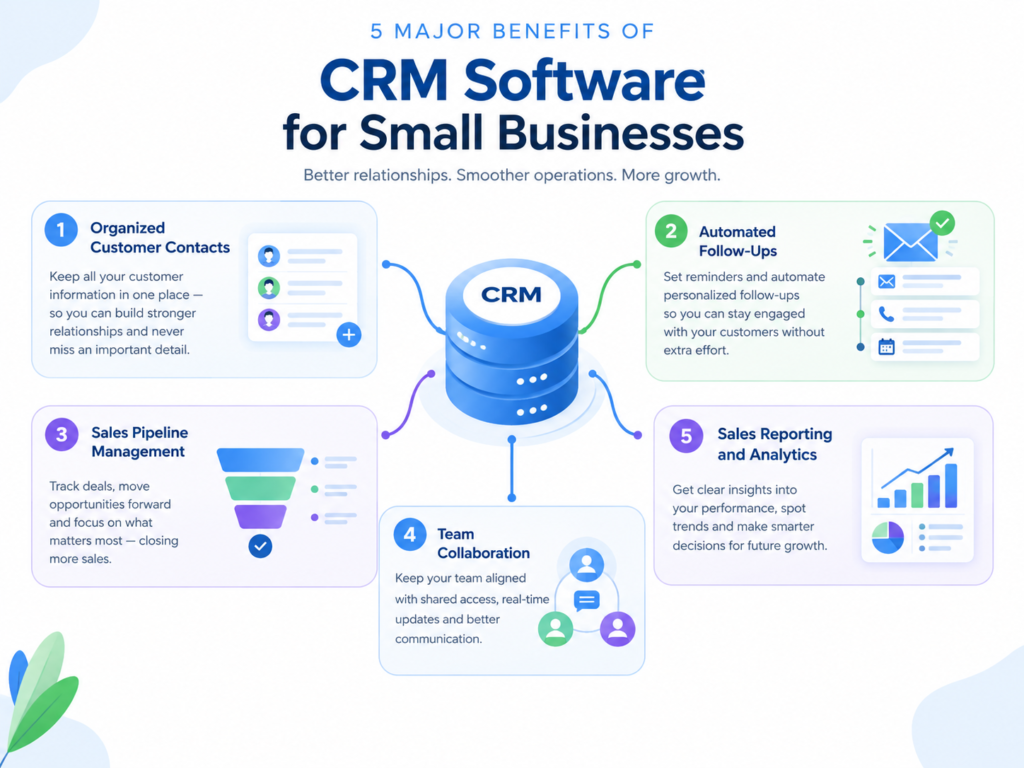
1. Keep Customer Information Organized
Imagine having customer information spread across Google Sheets, Gmail, WhatsApp, and your phone.
Finding the latest conversation or remembering when you last contacted someone can become difficult.
A CRM keeps important customer information together.
Your team can quickly see who the customer is, what they need, previous conversations, and where they are in the buying process.
2. Never Forget Important Follow-Ups
A missed follow-up can mean a missed sales opportunity.
CRM software can help you create tasks, reminders, and automated follow-ups.
Instead of relying on memory, you can use your CRM to keep track of the next action for every lead.
3. Manage Your Sales Pipeline
A sales pipeline shows where each prospect currently stands.
For example:
New Lead → Contacted → Qualified → Proposal → Negotiation → Won
A CRM makes it easier to see which deals are moving forward and which ones need attention.
4. Improve Team Collaboration
When customer information is stored in one place, everyone on your team can work from the same information.
A salesperson doesn’t have to ask another employee:
“What happened with this customer?”
They can simply check the customer’s CRM record.
5. Understand Your Sales Performance
Many CRM platforms provide reports and dashboards that help you understand your sales activity.
You may be able to track:
- Number of leads
- Deals won
- Deals lost
- Sales revenue
- Conversion rates
- Sales activities
- Pipeline value
This information can help you make better business decisions.
What Should Small Businesses Look for in CRM Software?
Not every CRM is suitable for a small business.
A platform may have hundreds of features, but that doesn’t mean you need all of them.
When comparing CRM software, focus on the features that solve your actual business problems.
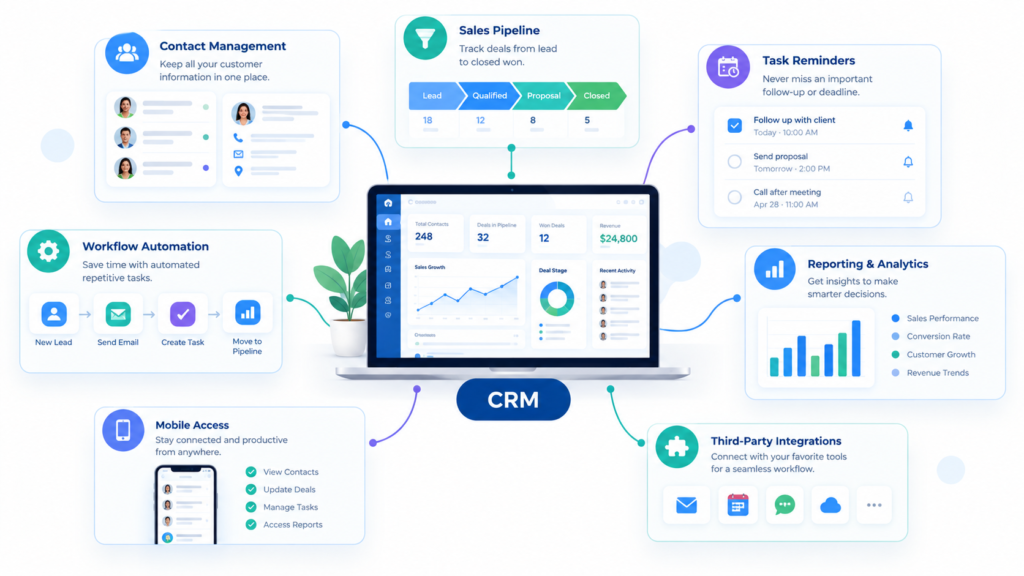
1. Easy Contact Management
The CRM should make it simple to add, organize, search, and update customer information.
You should be able to find a customer’s details quickly without navigating through complicated menus.
2. Sales Pipeline Management
A visual sales pipeline can help you understand where every opportunity stands.
Look for a CRM that lets you customize pipeline stages according to your sales process.
3. Task and Follow-Up Management
Reminders and tasks are especially useful for small teams.
Your CRM should make it easy to schedule calls, emails, meetings, and follow-ups.
4. Automation
Automation can save considerable time.
Depending on the platform, you may be able to automate:
- Lead assignments
- Follow-up reminders
- Email sequences
- Notifications
- Data entry
- Sales workflows
5. Reporting and Analytics
A good CRM should help you understand your sales performance without requiring you to become a data analyst.
Simple dashboards and reports are often more useful to small businesses than overly complicated analytics.
6. Mobile Access
Business doesn’t always happen from a desk.
Mobile access allows salespeople and business owners to check leads, update customer information, and manage tasks while working remotely or traveling.
7. Integrations
Check whether the CRM works with the tools you already use.
Useful integrations may include:
- Gmail
- Outlook
- Google Calendar
- Slack
- Accounting software
- Marketing platforms
- Customer support tools
- E-commerce platforms
Best CRM Software for Small Business
Here are several popular CRM platforms worth considering.
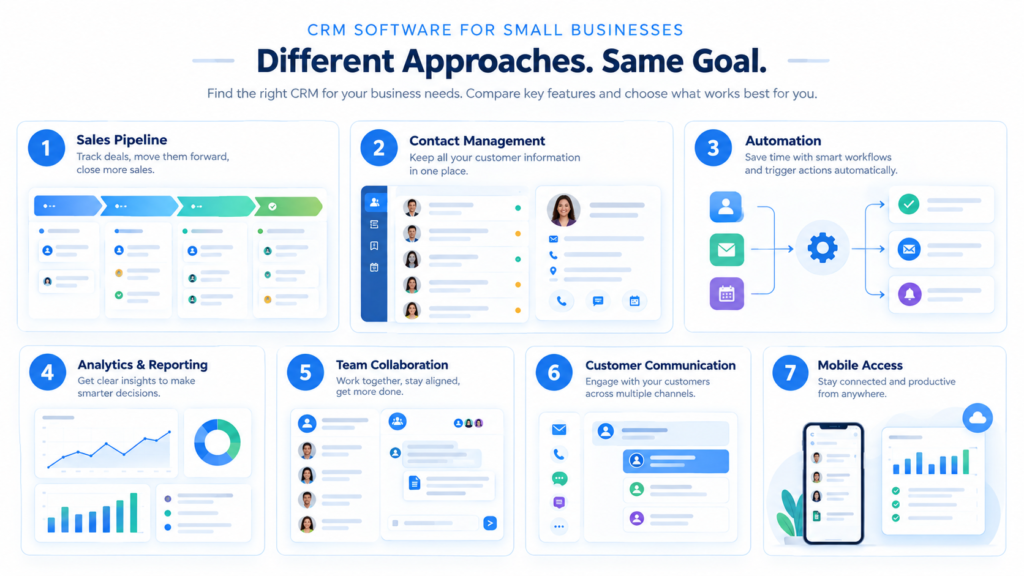
Rather than choosing one CRM for every business, think about which platform’s features, pricing model, and workflow match your specific needs.
1. HubSpot CRM
HubSpot CRM is widely known for its user-friendly interface and broad collection of sales, marketing, and customer service tools.
It can be a good option for small businesses that want to start with basic CRM functionality and potentially add more tools as the business grows.
Key Features
- Contact management
- Deal tracking
- Sales pipeline
- Email tracking
- Tasks and reminders
- Reporting
- Marketing tools
- Customer service tools
- Integrations
Why Consider HubSpot?
One of its biggest advantages is that businesses can build a broader customer-management system around the CRM rather than using a CRM only for sales.
Good for: Small businesses looking for an easy starting point and room to expand.
2. Zoho CRM
Zoho CRM is designed around sales management, automation, customer information, and business workflows.
It offers a large range of features and can be particularly useful for businesses that want more customization.
Key Features
- Lead management
- Contact management
- Sales automation
- Workflow automation
- Reports and dashboards
- Email integration
- Mobile applications
- AI-assisted features
- Business integrations
Why Consider Zoho CRM?
Zoho has a broad business software ecosystem, so companies already using other Zoho products may find it convenient to connect their workflows.
Good for: Small businesses looking for customization and a broad set of business tools.
3. Salesforce
Salesforce is one of the best-known CRM platforms in the market.
Although it is widely used by larger organizations, Salesforce also provides solutions aimed at smaller businesses.
Its major strength is the depth of its CRM ecosystem and customization capabilities.
Key Features
- Lead management
- Opportunity management
- Sales forecasting
- Workflow automation
- Reporting
- Customer service
- Marketing functionality
- App integrations
- Customization
Why Consider Salesforce?
Businesses with more complex sales processes may appreciate the platform’s flexibility.
However, smaller companies should consider whether they actually need its wider feature set before committing to a more sophisticated CRM environment.
Good for: Growing businesses with more complex sales and customer-management requirements.
4. Pipedrive
Pipedrive takes a sales-focused approach to CRM.
Its interface emphasizes the sales pipeline, making it easy to see where deals are in the buying process.
For businesses where sales pipeline management is the main priority, this approach can be useful.
Key Features
- Visual sales pipeline
- Lead management
- Deal tracking
- Sales activities
- Automation
- Email integration
- Reporting
- Mobile access
Why Consider Pipedrive?
The platform is built around helping sales teams understand what needs to happen next.
Good for: Small sales teams that want a straightforward, pipeline-focused CRM.
5. Freshsales
Freshsales is part of the Freshworks business software ecosystem.
It combines CRM functionality with sales automation, communication tools, and AI-assisted capabilities.
Key Features
- Contact management
- Lead scoring
- Deal management
- Email and communication tools
- Sales automation
- Reports
- AI-powered features
- Mobile access
Why Consider Freshsales?
Businesses already using Freshworks products may find it convenient to keep customer and sales workflows within the same ecosystem.
Good for: Small businesses looking for CRM, sales automation, and communication features.
6. monday CRM
monday CRM is built around a flexible visual workspace.
Businesses can customize boards, workflows, pipelines, and processes to fit the way their teams work.
Key Features
- Contact management
- Sales pipelines
- Custom workflows
- Automation
- Dashboards
- Task management
- Collaboration
- Integrations
Why Consider monday CRM?
Its flexible interface can work well for businesses that want to customize their CRM instead of following a rigid sales workflow.
Good for: Small teams that value flexibility and visual workflow management.
7. Bitrix24
Bitrix24 combines CRM functionality with collaboration and business-management tools.
Depending on the plan, businesses can use features related to CRM, communication, project management, and team collaboration.
Key Features
- Contact management
- Lead management
- Sales pipelines
- Task management
- Team collaboration
- Automation
- Communication tools
- Reports
Why Consider Bitrix24?
Businesses looking for CRM and broader team-management functionality in one platform may want to evaluate it.
Good for: Small businesses that want CRM combined with collaboration and productivity tools.
Best CRM Software for Small Business: Quick Comparison
| CRM | Best suited for | Main strength | Complexity |
|---|---|---|---|
| HubSpot CRM | Growing small businesses | Ease of use and broad ecosystem | Low–Medium |
| Zoho CRM | Customizable workflows | Features and flexibility | Medium |
| Salesforce | Growing sales organizations | Customization and ecosystem | Medium–High |
| Pipedrive | Sales-focused teams | Visual sales pipeline | Low–Medium |
| Freshsales | Sales and communication | Automation and AI features | Low–Medium |
| monday CRM | Flexible teams | Custom workflows | Low–Medium |
| Bitrix24 | All-in-one teams | CRM + collaboration | Medium |
Important: CRM plans, features, limits, and pricing can change over time. Always check the provider’s current plan details before purchasing.
Free CRM vs Paid CRM: Which Should You Choose?
Many small businesses start with a free CRM.
That’s perfectly reasonable if you’re testing whether CRM software fits your workflow.
A free CRM may provide enough functionality for:
- Contact management
- Basic lead tracking
- Simple sales pipelines
- Tasks
- Basic reporting
However, as your business grows, you may need features such as:
- Advanced automation
- More users
- Detailed reporting
- Marketing automation
- Advanced integrations
- Custom workflows
- AI features
- Higher data limits
The right approach is not necessarily to choose the cheapest CRM.
Instead, consider the total value the CRM provides to your business.
If a paid feature saves several hours of manual work every week or helps your team follow up with more leads, it may justify the additional cost.
How to Choose the Right CRM for Your Small Business
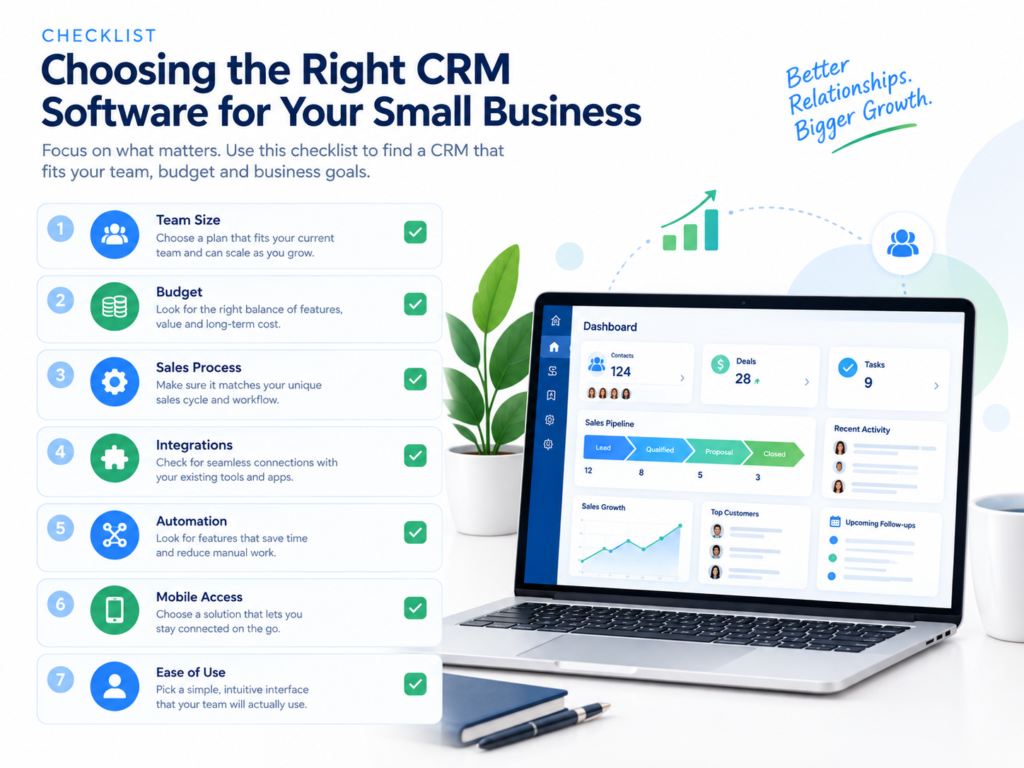
Before signing up for a CRM, ask yourself these questions.
How many people will use it?
A solo business owner may need a much simpler system than a 20-person sales team.
What is your primary goal?
Are you mainly trying to:
- Organize contacts?
- Increase sales?
- Improve follow-ups?
- Automate repetitive work?
- Manage customer support?
- Track marketing campaigns?
Your answer should influence which CRM you choose.
How complicated is your sales process?
If your sales process is simple, you probably don’t need a highly complicated CRM.
If you have multiple sales stages, teams, territories, or products, more advanced functionality may become important.
What tools do you already use?
Don’t forget integrations.
If your business depends heavily on Gmail, Google Calendar, accounting software, email marketing, or other applications, make sure your CRM works well with them.
Can your team actually use it?
This is one of the most overlooked factors.
A CRM can have hundreds of features, but if your employees find it confusing and avoid using it, it won’t provide much value.
Choose software your team can learn and use consistently.
Common CRM Mistakes Small Businesses Should Avoid
Buying CRM software is only the first step.
Here are some common mistakes that can reduce its value.
Choosing Too Many Features
More features don’t automatically mean a better CRM for your business.
Start with your most important requirements.
Not Training Your Team
Even an easy CRM needs proper setup and training.
Make sure employees understand how and when they should use it.
Keeping Incomplete Customer Data
A CRM is only useful when the information inside it is accurate.
Create simple rules for entering and updating customer information.
Ignoring Automation
Many businesses buy CRM software but continue doing everything manually.
Look for repetitive tasks that can be automated.
Failing to Review the CRM
Your business will change.
Review your CRM setup periodically and remove unnecessary fields, workflows, and processes.
Frequently Asked Questions About CRM Software
What is the best CRM software for a small business?
There isn’t one CRM that is ideal for every small business.
HubSpot, Zoho CRM, Salesforce, Pipedrive, Freshsales, monday CRM, and Bitrix24 all offer different approaches to customer and sales management.
The right option depends on your team size, budget, sales process, required integrations, and desired features.
Is CRM software worth it for a small business?
Yes, CRM software can be useful even for a small team when customer information, leads, and follow-ups are becoming difficult to manage manually.
The biggest benefit is usually having a centralized system for managing customer relationships and sales activity.
Can a small business use a free CRM?
Yes. Several CRM providers offer free plans or free tiers.
A free CRM can be a good way to test basic contact and sales management before investing in advanced features.
How much does CRM software cost?
CRM pricing varies significantly depending on the provider, number of users, features, and subscription plan.
Some platforms offer free plans, while advanced CRM systems can cost considerably more per user.
Always check current pricing directly with the provider before making a purchase.
What is the easiest CRM for beginners?
Ease of use depends on your business and previous experience.
Platforms such as HubSpot and Pipedrive are often considered relatively straightforward starting points, while platforms with extensive customization may require more setup.
Can CRM software help increase sales?
CRM software does not automatically increase sales.
However, it can help businesses organize leads, improve follow-ups, track opportunities, automate repetitive tasks, and understand their sales pipeline.
Those improvements can support a more consistent sales process.
Final Thoughts
The best CRM software for small business is not necessarily the platform with the longest feature list.
It is the one that solves your team’s actual problems without creating unnecessary complexity.
If you mainly need simple contact and sales management, a user-friendly CRM may be enough.
If your business needs customization and automation, a more advanced platform may make sense.
Before making a decision, compare the features you actually need, check integrations, test the user experience, and take advantage of free trials or free plans where available.
Most importantly, choose a CRM that your team will actually use consistently.
A well-organized CRM can turn scattered customer information into a clear sales process—and give a growing small business a much better foundation for building long-term customer relationships.
Also Read: Best VPN for iPhone (2026): Top Secure & Fast VPNs for Privacy, Streaming & Safe Browsing

