


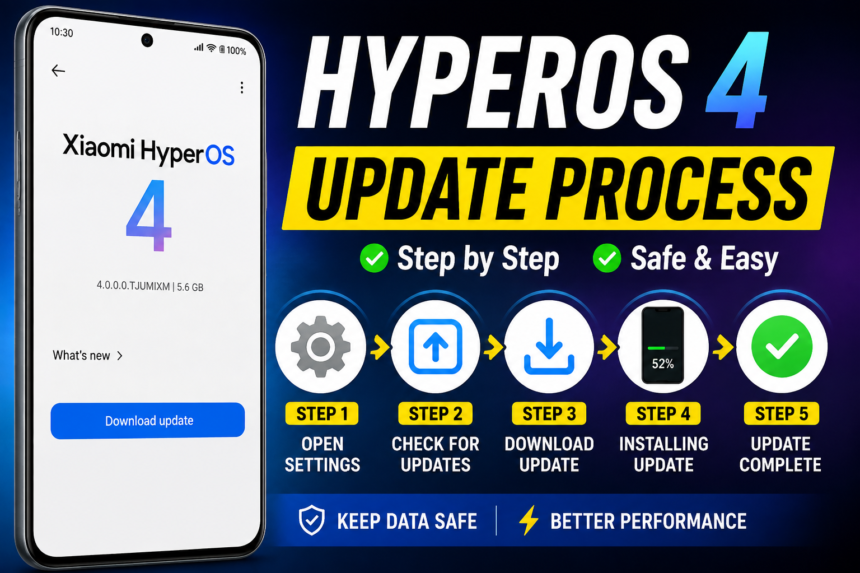
Xiaomi HyperOS 4 is officially here, bringing a major software upgrade built around Android 17, a redesigned interface, improved performance, deeper AI integration and new cross-device features. The first phase is focused on China, while Xiaomi has not yet published a complete global stable rollout schedule.
For Xiaomi, Redmi and POCO users, the biggest question is simple: Will my phone get HyperOS 4, and when will the update arrive?
Here is everything you need to know about Xiaomi HyperOS 4, including its release status, Android version, major features, expected supported devices, global availability and what users should expect from the rollout.
Xiaomi HyperOS 4 Release Date
Xiaomi officially unveiled HyperOS 4 in August 2026 and opened the beta program in China. The announcement marks the beginning of the new software generation, but it should not be confused with the worldwide stable release.
The most important distinction is between HyperOS 4 Beta, China stable firmware and global stable firmware.
At the moment, Xiaomi has not announced one universal date on which every supported Xiaomi, Redmi and POCO device will receive the stable update.
The initial rollout is expected to prioritize newer flagship devices before the update expands to mid-range phones, tablets and other supported products.
For international users, including those in Europe, India and other markets, the final timing can vary significantly depending on the device, region and firmware branch.
Xiaomi’s previous HyperOS rollout strategy also shows that software updates are normally delivered in waves rather than simultaneously to every eligible device.
HyperOS 4 rollout at a glance
| Region | Current status |
|---|---|
| China | Beta rollout underway |
| Global | Stable rollout date not fully announced |
| India | Global/India rollout expected after initial China deployment |
| Europe | Regional rollout expected later |
| Redmi | Rollout depends on individual model |
| POCO | Rollout depends on individual model |
| Tablets | Supported models will receive updates in phases |
Important: An eligible device does not necessarily receive the update on the first day. Xiaomi can use staged or soft releases to monitor stability before expanding an update to more users.
HyperOS 4 Is Based on Android 17
One of the biggest changes is the underlying Android generation.
HyperOS 4 is designed around Android 17, giving compatible Xiaomi devices access to the latest Android platform foundation along with Xiaomi’s own interface, AI and ecosystem features.
This is important because HyperOS is more than a visual skin. Xiaomi combines Android with its own system framework, applications, device connectivity services and hardware-specific optimizations.
However, Android 17 support alone does not guarantee that every phone running a previous HyperOS version will receive HyperOS 4.
Software eligibility depends on Xiaomi’s update policy, the device’s supported Android versions and the specific regional firmware.
What’s New in HyperOS 4?
HyperOS 4 focuses on several major areas:
- New visual design
- Better animations and responsiveness
- Improved memory management
- AI-powered system functions
- Smarter Notes and Recorder
- More capable system assistant
- Expanded Super Island integration
- Cross-device communication
- Privacy improvements
- Better tablet optimization
- New customization options
The result is intended to make Xiaomi devices feel more responsive while making AI a more integrated part of everyday tasks.
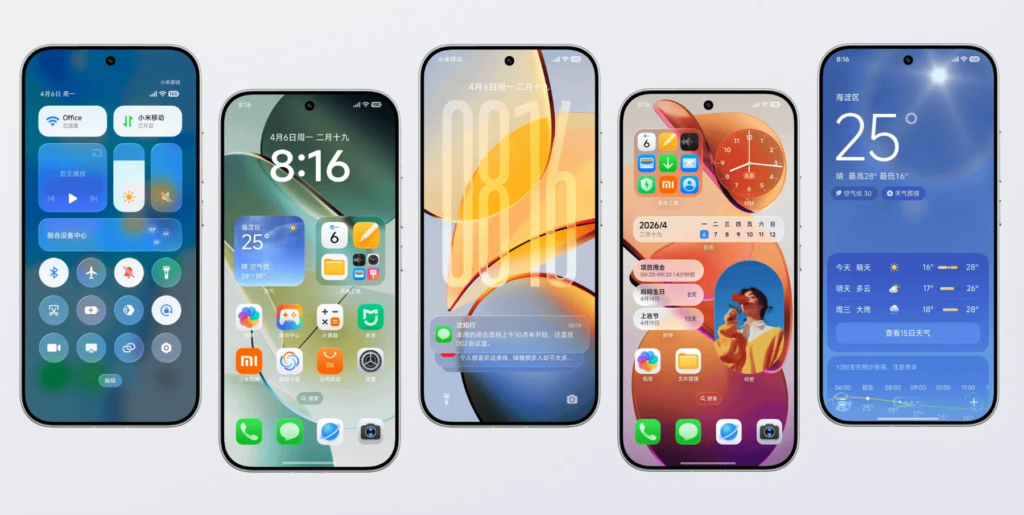
1. New Soft Light Glass Design
The most visible HyperOS 4 change is the redesigned interface.
Xiaomi introduces a visual language called Soft Light Glass, which uses transparency, lighting and dynamic visual effects to create a more layered appearance.
Instead of relying only on static colors, some interface elements can react to the content displayed behind them.
The system can dynamically adjust transparency and lighting to maintain readability while still providing the glass-like appearance.
Interaction also becomes more visual. Certain elements can respond to touch and movement with lighting effects.
However, the complete visual experience will not necessarily be identical on every Xiaomi phone.
Hardware capability matters, and some of the more advanced effects are intended for newer flagship-class processors.
That means a budget or older device may receive HyperOS 4 while missing some of the most demanding graphical effects.
2. Smoother Animations and Better Performance
HyperOS 4 is not simply a cosmetic upgrade.
Xiaomi has also worked on system performance, memory management and application responsiveness.
According to information compiled from Xiaomi’s HyperOS 4 testing, several core applications have been optimized to reduce resource consumption and improve responsiveness.
The launcher, Weather and Gallery applications have received architectural improvements, while system animations have also been optimized for situations involving multitasking, floating windows and screen rotation.
For everyday users, these changes could be more noticeable than a new wallpaper or icon design.
Opening applications, switching between apps, navigating the home screen and using floating windows should feel more consistent on supported hardware.
3. Faster Gallery Processing
The Gallery experience is another area receiving significant attention.
Xiaomi’s testing indicates major improvements when processing large photo libraries.
The company has reported substantially lower scanning time and reduced CPU and RAM usage in certain internal tests. These figures should be treated as laboratory measurements rather than guaranteed real-world results because performance depends on the device, storage, software version and number of files.
For people with thousands of photos and videos, however, this could be one of the more practical HyperOS 4 improvements.
4. Super XiaoAI 2.0 Brings More AI Features
Artificial intelligence is one of the biggest themes of HyperOS 4.
Xiaomi introduces Super XiaoAI 2.0, powered by the company’s MiMo large language model.
The assistant is designed to move beyond simple voice commands.
Instead of merely answering a question, the system can potentially understand a more complicated request, break it into steps and interact with supported applications.
For example, Xiaomi describes scenarios involving:
- Searching photographs
- Creating photo collections
- Planning trips
- Adding information to Calendar
- Controlling compatible smart-home devices
- Performing multi-step tasks
- Scheduling recurring actions
This represents a shift from a traditional voice assistant toward a more system-level AI agent.
Why this matters
The biggest advantage is convenience.
Imagine telling your phone:
“Find my travel photos, organize them and create a collection.”
Instead of manually opening Gallery, searching folders and selecting images, an AI agent could potentially perform multiple steps automatically.
The exact capabilities, languages and supported applications will depend heavily on the market.
5. Inspiration Ball
One of the more interesting HyperOS 4 features is Inspiration Ball.
It is designed to allow users to interact with content currently displayed on the screen.
For example, if an address appears on your screen, the assistant could identify it and help start navigation.
If you see a product, it could potentially help find similar information.
Other examples include extracting dates and locations from content and adding them to Calendar, or performing AI-powered image editing.
The feature is intended to reduce the number of steps required to move information from one application to another.
Xiaomi has indicated that this capability will be introduced through an OTA update and that availability can depend on device and software version.
6. Smarter Notes and Voice Recording
HyperOS 4 also gives AI a bigger role in productivity.
The Notes application can turn voice input into organized information and provide AI-assisted summaries.
This could be useful for:
- Meetings
- Lectures
- Interviews
- Personal reminders
- Ideas
- Work notes
The Recorder application also receives AI-based functions for identifying important sections and organizing recorded information.
Instead of manually listening to a long recording, users can potentially use AI-generated summaries to locate the most relevant information faster.
7. AI Calls
AI is also moving into phone calls.
On selected devices in China, HyperOS 4 introduces AI-powered call functionality that can help answer calls during specified periods and generate summaries afterward.
This could be particularly useful when users cannot immediately answer a call.
However, this is an important example of why users should not assume that every HyperOS 4 feature will arrive globally.
Xiaomi currently describes several advanced AI capabilities as being dependent on the Chinese version, supported devices and regional availability.
8. More Powerful Super Island
HyperOS 4 expands Xiaomi’s Super Island functionality.
The feature is designed to keep important ongoing activities visible without forcing users to repeatedly open individual applications.
According to current HyperOS 4 information, Xiaomi has expanded the number of supported services and added settings for managing which services can appear through Super Island.
This can be especially useful for activities such as:
- Deliveries
- Timers
- Navigation
- Calls
- Media playback
- Other supported real-time activities
The exact appearance and supported applications can vary by device and region.
9. Dual Phone Connectivity
HyperOS 4 also introduces features designed for people who own more than one Xiaomi smartphone.
With compatible devices connected to the same Xiaomi Account, certain notifications, calls and verification information can be synchronized between phones.
This can be useful for users who maintain a primary and secondary Xiaomi device.
The feature requires compatible hardware, software and account configuration, so it should not be considered a universal HyperOS 4 function.
10. Privacy and AI Security
The growing use of AI creates an obvious question:
What happens to personal data when an AI assistant can access information across the phone?
HyperOS 4 attempts to address this through permission controls and privacy mechanisms.
Xiaomi says Super XiaoAI is restricted by user permissions and can request confirmation before performing sensitive actions such as modifying or deleting information or sending data externally.
There are also controls for managing AI memory and stored information.
Some privacy features use a combination of on-device and cloud processing, depending on the task and device.
This will be an important area to watch as HyperOS 4 expands internationally.
HyperOS 4 Supported Devices
This is where Xiaomi users need to be careful.
There is currently a difference between:
officially confirmed HyperOS 4 beta devices
and
devices expected to receive the update based on software-support policies.
Xiaomi has not yet published one final worldwide stable-device list covering every Xiaomi, Redmi and POCO product.
Current compatibility information points to a broad range of newer flagship and mid-range devices, but the final rollout can change.
Xiaomi phones expected to receive HyperOS 4
The current compatibility information includes newer generations such as:
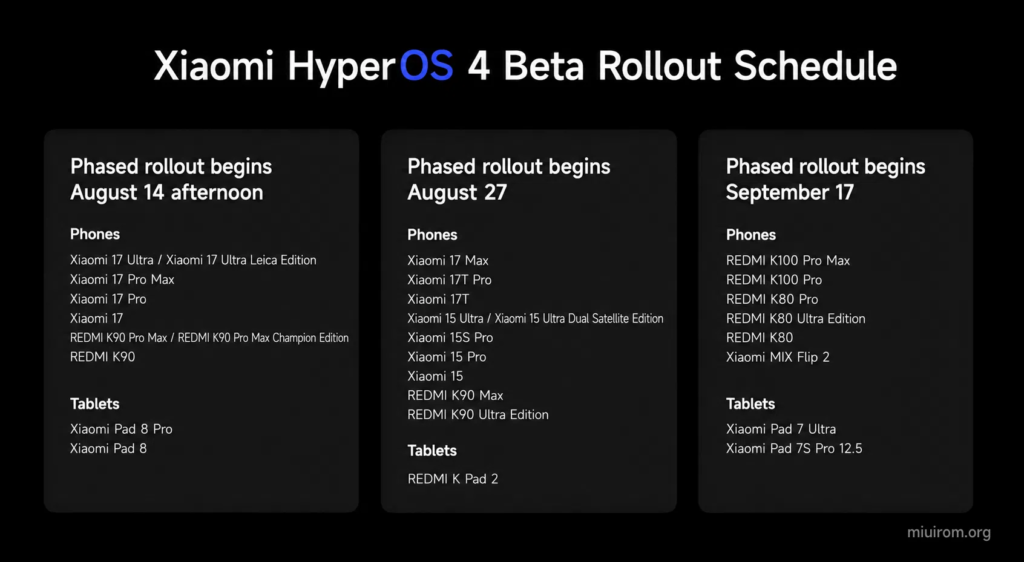
- Xiaomi 17 series
- Xiaomi 15 series
- Xiaomi 14 series
- Xiaomi 13 series
- Xiaomi 13T series
- Xiaomi Civi 4 Pro
- Xiaomi Civi 5 Pro
- Xiaomi MIX Flip
- Xiaomi MIX Flip 2
- Xiaomi MIX Fold 3
- Xiaomi MIX Fold 4
Selected newer Xiaomi tablets are also included, including:
- Xiaomi Pad 8
- Xiaomi Pad 8 Pro
- Xiaomi Pad 7
- Xiaomi Pad 7 Pro
- Xiaomi Pad 7 Ultra
- Xiaomi Pad 7S Pro
- Xiaomi Pad 6S Pro 12.4
- Xiaomi Pad Mini
These lists are based on current compatibility information and should not be treated as Xiaomi’s final global stable announcement.
Redmi HyperOS 4 Supported Devices
The Redmi ecosystem is considerably larger, so rollout timing will vary between series.
Current compatibility information includes newer models such as:
- Redmi K100 Pro series
- Redmi K90 series
- Redmi K80 series
- Redmi K70 series
- Redmi K60 Ultra
- Redmi 17 series
- Redmi Note 17 series
- Redmi Note 15 series
- Redmi Note 14 series
- Redmi Turbo 4 series
- Redmi Turbo 5 series
- Redmi K Pad
- Redmi K Pad 2
- Redmi Pad 2 series
Again, regional versions can have different software policies, so users should verify their exact model number and ROM region before assuming an update is guaranteed.
POCO HyperOS 4 Supported Devices
POCO users should also expect a phased rollout.
Current compatibility information points toward newer models including:
- POCO F8 Pro
- POCO F8 Ultra
- POCO F7
- POCO F7 Pro
- POCO F7 Ultra
- POCO X8 Pro
- POCO X8 Pro Max
- POCO X7
- POCO X7 Pro
- POCO M8 series
- POCO M7 series
- POCO X6 Pro
- Selected POCO tablets
The final global list is still dependent on Xiaomi’s official rollout announcements.
Which Xiaomi Phones May Not Get HyperOS 4?
Not every Xiaomi, Redmi or POCO phone will receive every major Android upgrade.
Current compatibility information indicates that several older devices are unlikely to move to HyperOS 4.
Examples include:
- Xiaomi 12 series
- Xiaomi 13 Lite
- Xiaomi Civi 3
- Xiaomi MIX 4
- Xiaomi MIX Fold 2
- Several older Redmi A-series models
- Redmi Note 13 models with lower Android support ceilings
- Older Redmi Note generations
- Older POCO models that have completed their major-update cycles
However, users should wait for the final official model-by-model announcement before treating any unofficial exclusion list as absolutely final.
Will Redmi Note 13 Get HyperOS 4?
This is likely to be one of the most searched questions.
The answer is model-dependent.
Different Redmi Note 13 variants have different update histories and Android-version limits. Current compatibility information suggests that several Note 13 models may not qualify for an Android 17-based HyperOS 4 upgrade.
Therefore, Redmi Note 13 owners should not assume that every phone in the series will receive the same software version.
Check the exact model:
Settings → About phone → Detailed info and specs
Then compare the exact model with Xiaomi’s official update information once the global list is published.
Xiaomi unveils its brand new design language with HyperOS 4 pic.twitter.com/K1OPMTVMAv
— Noah Cat (@Cartidise) August 14, 2026Will POCO F7 Get HyperOS 4?
The POCO F7 series is among the newer POCO generations and is currently included in compatibility information for HyperOS 4.
The F7, F7 Pro and F7 Ultra are therefore strong candidates for the upgrade.
However, the availability date can differ between China, Global, India and European firmware.
A phone being eligible does not mean that the OTA update will arrive simultaneously in every country.
HyperOS 4 Global Release: What Should Users Expect?
The global rollout is likely to happen in stages.
A typical Xiaomi rollout follows a pattern similar to:
China Beta → China Stable → Global Beta/Testing → Global Stable → Regional Rollout → Wider OTA Distribution
The actual sequence can differ between products.
Flagship devices normally receive priority because they provide Xiaomi with a controlled platform for testing the new software.
Mid-range and budget devices usually follow later.
Xiaomi’s HyperOS 3 rollout also used multiple waves rather than one universal launch date, with different groups of devices receiving updates at different times.
HyperOS 4 India Release Date
For Indian users, there is currently no single official stable release date covering every compatible device.
The India rollout will probably follow the global deployment after Xiaomi completes sufficient testing.
Users should also remember that Xiaomi can distribute updates using different firmware branches.
For example, a Global ROM, European ROM and Indian ROM can have different build numbers and release schedules.
Therefore:
Global release ≠ immediate India release.
If Xiaomi begins the global rollout in September, a specific Indian phone may still receive the OTA weeks later.
How to Check for HyperOS 4 Update
When the update becomes available for your device, you can check manually.
Method 1: System Update
- Open Settings
- Select About phone
- Tap the HyperOS version
- Select Check for updates
- Download and install the update if available
Method 2: Automatic Updates
You can also enable automatic system updates if the option is available on your device.
Because major Android updates can be large, it is recommended to use a stable Wi-Fi connection and keep sufficient free storage available.
Should You Install HyperOS 4 Beta?
Beta software is mainly intended for testing.
If your phone is your primary work or communication device, installing beta firmware may not be the best choice.
Beta versions can contain:
- Application compatibility problems
- Battery drain
- Bugs
- Animation issues
- Connectivity problems
- Camera problems
- Unexpected crashes
For most users, waiting for the stable OTA update is the safer option.
Enthusiasts and developers who understand the risks may choose beta testing to experience new features earlier.
HyperOS 4 vs HyperOS 3
| Feature | HyperOS 3 | HyperOS 4 |
|---|---|---|
| Android foundation | Android 16 generation | Android 17 generation |
| Interface | Refined HyperOS design | New Soft Light Glass style |
| AI | HyperAI features | Expanded system-level AI |
| Assistant | Existing AI assistant capabilities | Super XiaoAI 2.0 |
| Widgets | Standard/custom widgets | Widget stacks |
| Notifications | Existing layout | New stacked presentation |
| Gallery | Improved search and organization | Deeper performance optimization |
| AI Notes | Available on supported devices | More advanced organization |
| Cross-device features | HyperConnect | Further expansion |
| Privacy | Enhanced safeguards | Expanded AI privacy controls |
HyperOS 3 already introduced major improvements in AI, HyperConnect, the Gallery and the overall interface, while HyperOS 4 pushes further toward AI-assisted system interaction and visual redesign.
Is HyperOS 4 a Major Update?
Yes.
HyperOS 4 is more than a simple security patch or cosmetic refresh.
The combination of Android 17, a redesigned interface, system optimization, expanded AI capabilities and cross-device functionality makes it a significant software-generation upgrade.
However, the experience will vary considerably depending on hardware.
A flagship Xiaomi phone may receive advanced visual effects and AI functions that are unavailable on an entry-level Redmi device.
This is normal for modern Android software.
What Will Be Different on Older Xiaomi Phones?
Older supported phones may receive the core HyperOS 4 software while missing certain advanced features.
This can happen because of:
- Processor limitations
- RAM capacity
- GPU capabilities
- Camera hardware
- Regional restrictions
- Language support
- AI processing requirements
- Application compatibility
Therefore, “receives HyperOS 4” does not necessarily mean “receives every HyperOS 4 feature.”
Xiaomi itself notes across its HyperOS ecosystem that feature availability can depend on device model, system version and region.
Final Verdict
Xiaomi HyperOS 4 is shaping up to be one of Xiaomi’s most ambitious software updates yet.
The biggest change isn’t just the new glass-inspired interface. Xiaomi is increasingly turning HyperOS into an ecosystem platform where AI, smartphones, tablets and connected devices work together more intelligently.
For users, the most exciting improvements are likely to be:
Android 17 + Soft Light Glass UI + Super XiaoAI 2.0 + smarter Notes and Recorder + improved performance + expanded Super Island + stronger cross-device functionality.
But there is one important caveat: HyperOS 4 will not provide an identical experience on every Xiaomi, Redmi and POCO device.
Hardware, region, firmware version and language can all affect feature availability.
For now, users should avoid installing unofficial ROMs simply because a website claims that a particular model is eligible. The safest route is to wait for Xiaomi’s official OTA rollout or verify the firmware through Xiaomi’s official channels.
Xiaomi’s official HyperOS information also emphasizes that update timing and feature availability can vary by device and region.
As Xiaomi expands HyperOS 4 beyond its initial Chinese testing phase, the most important information to watch will be the official global device list, regional rollout dates and which AI features actually make it to international versions.
Frequently Asked Questions(FAQs)
What is HyperOS 4?
HyperOS 4 is Xiaomi’s latest major operating-system generation, built around Android 17 and introducing a redesigned interface, performance improvements, expanded AI capabilities and new ecosystem features.
Is HyperOS 4 based on Android 17?
Yes. Current HyperOS 4 information identifies Android 17 as its underlying Android generation.
When will HyperOS 4 launch globally?
Xiaomi has not announced one universal global stable-release date for all devices. The rollout is expected to happen progressively after the initial China testing phase.
Will my Redmi phone receive HyperOS 4?
That depends on the exact model. Newer Redmi generations have a much stronger chance of receiving the update, while older models may have reached their maximum Android upgrade.
Will POCO phones receive HyperOS 4?
Yes, several newer POCO models are expected to receive HyperOS 4, but the exact timing will vary by model and region.
Will every HyperOS 4 phone get the same features?
No. Some AI, graphical and connectivity features require specific hardware, applications, languages or regions.
Should I install the HyperOS 4 beta?
If your phone is your primary device, waiting for the stable version is generally safer. Beta firmware can contain bugs and compatibility problems.
How can I check my HyperOS version?
Go to Settings → About phone → HyperOS version and check for available system updates.
Is HyperOS 4 better than HyperOS 3?
HyperOS 4 is designed as the next major generation and adds Android 17, a new visual language, expanded AI functions and additional system improvements. Whether the upgrade feels significant depends on your device.
Sources and verification
- Xiaomi HyperOS official information: Xiaomi HyperOS
- Xiaomi Community: Xiaomi HyperOS 4 announcement
- Xiaomi Product Security Center: Xiaomi AER device information
Also Read: Best VPN for iPhone (2026): Top Secure & Fast VPNs for Privacy, Streaming & Safe Browsing

